Interoperate C++ and Fortran: Call Fortran from C++
In this short blog, I would write down some snippets to show how to call Fortran subroutines and functions from C++ program. Three different cases are discussed.
Case 1: subroutines/functions involving only scalars
We begin with some simple tasks
- increase the value of an integer variable by one
- return the sum of two double-type variables
Solutions to the two tasks will be implemented in Fortran, and used or called from C++ main program.
We first define the interface in the header file. To bridge Fortran and C++, we need C as the intermediary. Further more, since Fortran always parse arguments by reference, we need to use pointers as the parameters.
1
2
3
4
5
6
7
8
9
10
11
12
// interface.h
#pragma once
#ifdef __cplusplus
extern "C" {
#endif

void increase_by_one(int *i1);
double multiply_d(double *d1, double *d2);

#ifdef __cplusplus
}
#endif
The main program looks like below. It calls the two functions and prints the variables.
1
2
3
4
5
6
7
8
9
10
11
12
13
14
15
16
17
18
// main.cpp
#include "interface.h"
#include <iostream>
int main()
{
    int i;
    i = 2;
    std::cout << i << std::endl;
    increase_by_one(&i);
    std::cout << i << std::endl;

    double d1, d2, d3;
    d1 = 1.5;
    d2 = 4.0;
    d3 = multiply_d(&d1, &d2);
    std::cout << d1 << " x " << d2 << " = " << d3 << std::endl;
    return 0;
}
Now we go to the Fortran implementation. We implement the two functions in a single file myfuncs.f90. The major difference from the normal Fortran subroutines or functions is the bind keyword and the declaration of arguments.
Usually, Fortran compiler will generate the symbol of the procedure by adding _ as suffix. This is exactly suppressed by bind(C). The value parsed to name is the actual name of symbol which we shall call in C/C++. It can be set different from the subroutine name, but we keep them same for simplicity. The types of C arguments and return value should be declared by the types from iso_c_binding.
1
2
3
4
5
6
7
8
9
10
11
12
13
! myfuncs.f90
subroutine increase_by_one(i) bind(C, name="increase_by_one")
    use iso_c_binding, only: c_int
    integer(kind=c_int), intent(inout) :: i
    i = i + 1
end subroutine

function multiply_d(d1, d2) result(d3) bind(C, name="multiply_d")
    use iso_c_binding, only: c_double
    real(kind=c_double), intent(in) :: d1, d2
    real(kind=c_double) :: d3
    d3 = d1 * d2
end function
That’s all of the codes. To help compile the program, we need to Makefile. Note that the Fortran compiler is used as the linker. I didn’t try using C++ (g++ here), but it should be possible to link by adding the Fortran library (-lgfortran).
1
2
3
4
5
6
7
8
9
10
11
12
13
14
15
16
17
18
19
20
21
22
23
24
25
CXX = g++
FC = gfortran
LINKER = $(FC) -lstdc++
# if use ifort, you need to add -nofor-main

FCFLAGS = -g -Wall
CXXFLAGS = -g -Wall
LDFLAGS =
TARGET = test.exe

CXXSRC = main.cpp
F90SRC = myfuncs.f90
OBJS = $(patsubst %.cpp,%.o,$(CXXSRC)) $(patsubst %.f90,%.o,$(F90SRC))

$(TARGET): $(OBJS)
	$(LINKER) -o $@ $^ $(LDFLAGS)

%.o: %.cpp
	$(CXX) -c $(CXXFLAGS) $< -o $@

%.o: %.f90
	$(FC) -c $(FCFLAGS) $< -o $@

clean:
	rm -f *.o *.exe *.mod
Now issue make to compile the whole program, and run the program. As seen, the results are correct! 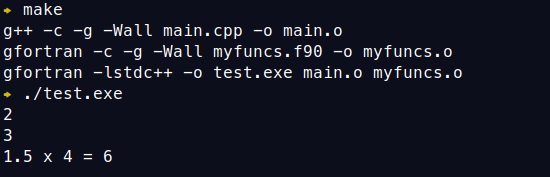
Case 2: functions involving C array
This time we try to sum a C array of double types. In the main program, the C array is dynamically allocated in the heap at runtime, and its members are randomized by the <random> utilities in the C++ standard library. In display_sum_da, the array is displayed and its sum is obtained by calling sum_da, which is implemented in Fortran.
1
2
3
4
5
6
7
8
9
10
11
12
13
14
15
16
17
18
19
20
21
22
23
24
25
26
27
28
29
30
// main.cpp
#include "interface.h"
#include <iostream>
#include <random>
#include <ctime>

static void display_sum_da(const int &size, double *da)
{
    for (int i = 0; i < size - 1; i++)
        std::cout << da[i] << " + ";
    if (size > 0)
        std::cout << da[size-1];
    double sum = sum_da(&size, da);
    std::cout << " = " << sum << std::endl;
}

int main()
{
    const int size = 5;
    static std::default_random_engine e(time(0));
    std::uniform_real_distribution<double> random_double(-1, 1);
    double * da = new double [size];

    for (int i = 0; i < size; i++)
        da[i] = random_double(e);
    display_sum_da(size, da);
    delete [] da;

    return 0;
}
The interface.h file looks like this.
1
2
3
4
5
6
7
8
9
10
11
// interface.h
#pragma once
#ifdef __cplusplus
extern "C" {
#endif

double sum_da(const int *size, double *da);

#ifdef __cplusplus
}
#endif
For the Fortran code, we need additional bindings to handle C pointer. For type declaration, the Fortran type corresponding to C pointer is c_ptr, which is a derived type. In our case, the C pointer is a double pointer. According to the GNU documentation, it should have a value attribute. c_ptr cannot be directly used to sum up. We need to associate c_ptr with a Fortran pointer of correct C data type. This is exactly done by c_f_pointer. Then we process the data pointed by c_ptr using the Fortran pointer.
1
2
3
4
5
6
7
8
9
10
11
12
13
14
15
! myfuncs.f90
function sum_da(size, da) result(d) bind(C, name="sum_da")
    use iso_c_binding, only: c_int, c_double, c_ptr, c_f_pointer
    integer(c_int), intent(in) :: size
    type(c_ptr), value :: da
    real(kind=c_double) :: d
    integer :: i
    real(kind=c_double), pointer :: da_f(:)

    call c_f_pointer(da, da_f, [size])
    d = 0.0d0
    do i = 1, size
      d = d + da_f(i)
    enddo
end function
The makefile is the same. We now compile and run the code. The answer is correct.

Case 3: subroutines involving Fortran dynamical array
Suppose that we need to call a Fortran procedure from an external library. This procedure takes an allocatable variable, or dynamical array as argument. For example, a generator of Fibonacci series can be written as follows in a module called external.f90
1
2
3
4
5
6
7
8
9
10
11
12
13
14
15
16
17
18
19
20
21
22
! external.f90
module external
  contains
  subroutine fibonacci(nsize, da)

    integer, intent(in) :: nsize
    integer, allocatable, intent(inout) :: da(:)

    integer :: i
    if(.not.allocated(da)) then
      allocate(da(nsize))
    endif
    da(:) = 1
    do i = 1, nsize
      if (i .eq. 1 .or. i .eq. 2) then
        cycle
      endif
      da(i) = da(i-1) + da(i-2)
    enddo

  end subroutine
end module
To call it from our myfuncs.f90, we need the help of an allocatable, as the pointer can not be parsed to fibonacci as argument.
1
2
3
4
5
6
7
8
9
10
11
12
13
14
15
16
17
18
19
20
21
22
! myfuncs.f90
subroutine my_generate(nsize, ia_c) bind(C, name="my_generate")
  use iso_c_binding, only: c_int, c_ptr, c_f_pointer
  use external, only: fibonacci
  implicit none

  integer(kind=c_int), intent(in) :: nsize
  type(c_ptr), value :: ia_c

  ! local varaibles
  integer(kind=c_int), pointer :: ia_f(:)
  integer, allocatable :: ia_f_dyn(:)

  allocate(ia_f_dyn(nsize))
  call fibonacci(nsize, ia_f_dyn)
  ! copy back
  call c_f_pointer(ia_c, ia_f, [nsize])
  ia_f = ia_f_dyn
  if(allocated(ia_f_dyn)) then
    deallocate(ia_f_dyn)
  endif
end subroutine
Note that if the external procedure is not defined in a module, an explicit interface should be written in our procedure.
1
2
3
4
5
6
interface
   subroutine fibonacci(n, ia)
     integer, intent(in) :: n
     integer, allocatable, intent(inout) :: ia(:)
   end subroutine
end interface
The interface file
1
2
3
4
5
6
7
8
9
10
11
// interface.h
#pragma once
#ifdef __cplusplus
extern "C" {
#endif

void my_generate(const int *size, int *ia);

#ifdef __cplusplus
}
#endif
and the main file
1
2
3
4
5
6
7
8
9
10
11
12
13
14
15
16
17
18
19
20
21
22
// main.cpp
#include "interface.h"
#include <iostream>

static void generate_and_display(const int &size, int *ia)
{
    my_generate(&size, ia);
    for (int i = 0; i < size; i++)
        std::cout << ia[i] << " ";
    std::cout << std::endl;
}

int main()
{
    const int size = 9;
    int * ia = new int [size];

    generate_and_display(size, ia);
    delete [] ia;

    return 0;
}
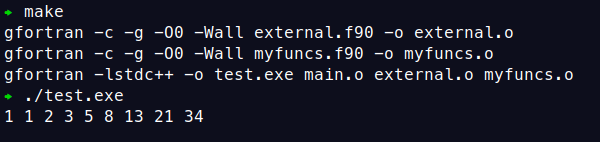
Now add external.f90 before myfuncs.f90 in the Makefile, and compile the program. Running it should give the correct result.
Conclusion
Calling Fortran procedures, either by oneself or from external libraries, from C++ program is briefly discussed. Codes for each of the three cases can be found in tarballs:
- Case 1: no_array.tar.gz,
- Case 2: with_array.tar.gz, and
- Case 3: with_allocatable.tar.gz.
I hope someone may find them useful, and welcome any suggestions to improve the code.